The House of the Seven Gables
I. About the Novel : Plot

The house was built on ground wrongfully seized from its rightful owner, Matthew Maule, by Colonel Pyncheon, the founder of the Massachusetts branch of the family. Maule was accused of practicing witchcraft and was executed. According to legend, at his death Maule laid a curse upon the Pyncheon family. During the housewarming festivities, Colonel Pyncheon was found dead in his armchair; whether he actually died from the curse or from a congenital disease is unclear. His portrait remains in the house as a symbol of its dark past and the weight of the curse upon the spirit of its inhabitants.
Phoebe arranges to visit her country home, but plans to return soon. Clifford, depressed by his isolation from humanity and his lost youth spent in prison, stands at a large arched window above the stairs and has a sudden urge to jump. The departure of Phoebe, the focus of his attention, leaves him bed-ridden.
Judge Pyncheon arrives to find information about land in Maine, rumored to belong to the family. He threatens Clifford with an insanity hearing unless he reveals details about the land or the location of the missing deed. Clifford is unable to comply. Before Clifford can be brought before the Judge (which would destroy Clifford's fragile psyche), the Judge mysteriously dies while sitting in Colonel Pyncheon's chair. Hepzibah and Clifford flee by train. The next day, Phoebe returns and finds that Holgrave has discovered the Judge's body. The townsfolk begin to gossip about Hepzibah and Clifford's sudden disappearance. Phoebe is relieved when Hepzibah and Clifford return, having recovered their wits.
New evidence in the crime that sent Clifford to prison proves his innocence. He was framed for the death of his uncle by Jaffrey, who was even then looking for the missing deed. Holgrave is revealed as Maule's descendant, but he bears no ill will toward the Pyncheons. The missing deed is discovered behind the old Colonel's portrait, but the paper is worthless: the land is already settled by others. The characters abandon the old house and start a new life in the countryside, free from the burdens of the past
Works Cited (参考文献)
II. Versions of the Novel in the Mass Media
The house of the seven gables which became a model.
There is this mansion in famous Salem as witch hunting in old days and is opened to public.
The curse of the crime that the ancestors who hung in the mansion committed is a story to fall on a descendant with a novel, but a spell does not suffer from really this mansion because it is fiction.
The inside of this mansion is introduced the animation.
There is this mansion in famous Salem as witch hunting in old days and is opened to public.
The curse of the crime that the ancestors who hung in the mansion committed is a story to fall on a descendant with a novel, but a spell does not suffer from really this mansion because it is fiction.
The inside of this mansion is introduced the animation.
Works Cited (参考文献)
III. About the Author :
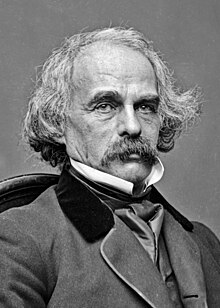
Nathaniel Hawthorne ( born Nathaniel Hathorne; July 4, 1804 – May 19, 1864) was an American novelist, Dark Romantic, and short story writer.
He was born in 1804 in Salem, MassachusettsSalem, to Nathaniel Hathorne and the former Elizabeth Clarke Manning. His ancestors include John Hathorne, the only judge involved in the Salem witch trials who never repented of his actions. Nathaniel later added a "w" to make his name "Hawthorne" in order to hide this relation. He entered Bowdoin College in 1821, was elected to Phi Beta Kappa in 1824, and graduated in 1825. Hawthorne published his first work, a novel titled Fanshawe, in 1828; he later tried to suppress it, feeling it was not equal to the standard of his later work. He published several short stories in periodicals, which he collected in 1837 as Twice-Told Tales. The next year, he became engaged to Sophia Peabody. He worked at the Boston Custom House and joined Brook Farm, a transcendentalist community, before marrying Peabody in 1842. The couple moved to The Old Manse in Concord, Massachusetts, later moving to Salem, the Berkshires, then to The Wayside in Concord. The Scarlet Letter was published in 1850, followed by a succession of other novels. A political appointment as consul took Hawthorne and family to Europe before their return to Concord in 1860. Hawthorne died on May 19, 1864, and was survived by his wife and their three children.
Much of Hawthorne's writing centers on New England, many works featuring moral allegories with a Puritan inspiration. His fiction works are considered part of the Romantic movement and, more specifically, Dark romanticism. His themes often center on the inherent evil and sin of humanity, and his works often have moral messages and deep psychological complexity. His published works include novels, short stories, and a biography of his college friend Franklin Pierore.
IV. My Reaction
A. Reaction Point - setting (設定、背景、場所)
- The context in time and place in which the action of a story occurs.
- She was unhappy person, in an unhappy house、Miss Hepzibah Pyncheon lived in the House of the Seven Gables, on Pyncheon Steet. It was a dark old house.
- Live in the house of the seven gables and become unhappy by curse.
B. Reaction Point -
characte(登場人物)
- The person who comes out to a story.
- Colone Pyncheon / Judge Jaffrey Pyncheon / Hepzi Pyncheon / Phoebr Pyncheon / Holgrave / Clifford Pyncheon /
- Colone Pyncheon→The person who abused wich hunting, and executed Maukle, and took land. Judge Jaffrey Pyncheon→The person who gained success as a lawyer. Hepzi Pyncheon→old maid. Phoebr Pyncheon→Daughter od the whole families who came out of the country. Holgrave→The young phootographer who is lodging at the mansion. Clifford Pyncheon→Older brother of the person imprisoned on the charge of grandfather homicide.
C. Reaction Point - motif (このような事件のイメージ、テーマやタイプなどの定期的な要素)
- Motif is a recurring element, such as an image, theme, or type of incident .
- God will him blood to drink!
- Words told to have cried right befoer Maule died became the spell.
D. My General Opinion
Ancestors concerned with witch hunting of Salem as a judge were really, and the author seemed to have a sense of guilt with a pride in it and thought whether the pin juns which a crime and the spell followed in spite of being a noble family was a projection of the figures of the author.

Hi, Kaho.
返信削除Your blog is very interesting.
I want to read 'The House of the Seven Gables'.
Hello Kaho,
返信削除Thank you for this strong effort. I especially appreciate your Reaction Points. This is the most interesting section of your blog post. In particular, your General Opinion is well worth reading and is an intriguing idea.
Hello Kaho,
返信削除Your general opinion is profoud. I admired your opinion.
Thank you for your great blog.
Hello Kaho,
返信削除I did not this book.
I read this blog, Ithought it was very interesting likely this.
Hi!
返信削除I agree with your opinion.
I thought there is similar content.How about you?
Hi!
返信削除I agree with your opinion.
I thought there is similar content.How about you?